Today visitors to Sweetwater Creek State Park often come in search of the haunting ruins of the New Manchester Manufacturing Company, the once-thriving textile mill village destroyed during the Civil War in July 1864.
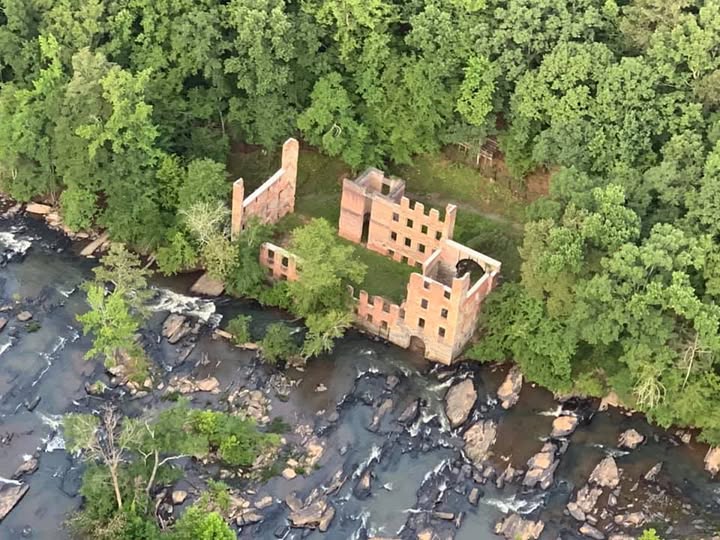
Yet just upstream from that famous site stood another important industrial operation—one that has largely slipped from public memory.
There, on the banks of Sweetwater Creek, Angus Ferguson operated a mill complex that for decades supplied both the surrounding countryside and the textile factory downstream.
Though far less visible today than the New Manchester ruins, Ferguson’s enterprise played a vital role in the economic life of old Campbell County and the surrounding area.
Angus Ferguson was born around 1812 in Cumberland County, North Carolina. His father, Daniel Ferguson (1767-1842), had immigrated from Scotland to America as a small child. By the early nineteenth century the Ferguson family had moved south into Georgia, joining the steady migration of Scots Irish settlers who established farms and communities across the Chattahoochee River frontier.
Daniel Ferguson eventually settled in what was then DeKalb County, an area that later became part of Fulton County. He was among the early members of Mount Gilead United Methodist Church near present-day Ben Hill. The church was organized in 1824 and is thought to be Fulton County’s oldest church. I researched and wrote an article about the church’s campground site in October 2024 that can be found at this link.
An early church history for Mount Gilead describes Daniel Ferguson as a man of commanding presence—“a gentleman of the old school type, with beaver hat and walking stick,” and that his plantation lay near an area once occupied by a large Native American encampment.
Daniel Ferguson’s sister, Flora (1771-1859) married Joseph Stone, Sr. (died 1847), namesake for Stone Road in South Fulton and patriarch for the Stone family who continued to own large tracts of Joseph’s property through the 1990s. Ferguson and Stone family members tell how a trumpet was blown in the community when Flora passed in 1859 to alert the countryside she had gone to Heaven.
Daniel Ferguson, Flora (Ferguson) Stone, her husband, and other extended family members are buried at the Ferguson-Stone Cemetery located on a crest overlooking I-285 behind an apartment complex along N. Desert Drive, S.W. off Stone Road.
The Ferguson family’s connections spread widely across the developing settlements of southwest Atlanta. Daniel Ferguson’s daughter and Angus Ferguson’s sister, Isabella (1814-1900), married Thomas Jefferson Perkerson (1805-1878), who served as an early sheriff of Fulton County. Through this marriage the Ferguson family became closely tied to the Perkerson family, early settlers in what would later become the Sylvan Hills and Perkerson Park sections of Atlanta. Sheriff Perkerson’s home stood for many years along Perkerson Road which at one time was part of the Rough and Ready Road.
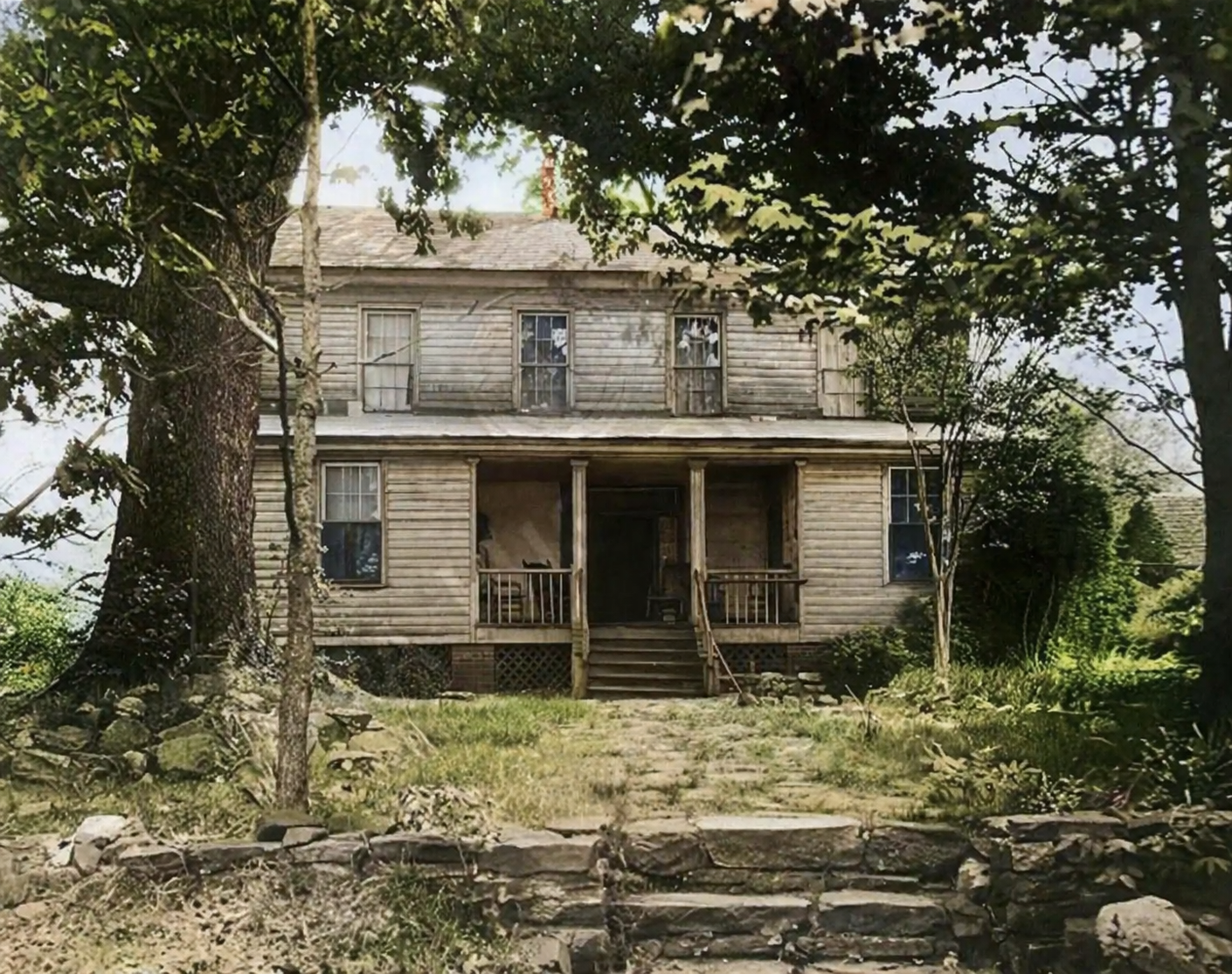
Pivoting back to Angus Ferguson and his mill site on Sweetwater Creek some sources state he took part in the 1832 Indian Territory Survey on the west side of the Chattahoochee River as a member of a survey team, and during this time he discovered what he thought would be the perfect place for mill.
Digging into the Field Notebooks and District Plat Records for the 1832 Survey I found John Lawhon listed as the surveyor for the section that would include the land along Sweetwater Creek where Ferguson’s Mill was located. This doesn’t mean that Angus Ferguson didn’t take part in some way with a survey team, it just means he wasn’t the surveyor of record. It could or couldn’t have happened. I just don’t have enough information to prove it in my present research journey.
At this point you might have some questions for me if you know the area along Sweetwater Creek has long been thought of as part of old Campbell County from its founding in December 1828 until it fell into Douglas County when it formed in October 1870.
How could land along Sweetwater Creek still be part of a survey taking place in 1832?
The answer lies in the fact that Campbell County did not remain fixed in its original form. When it was established, the county was carved from land already belonging to older counties—primarily areas that had entered Georgia’s system through earlier Creek cessions and distributions. But that was only the beginning of its story.
Just a few years later, the landscape changed again. The Cherokee cession opened vast new territory to the west and north, and in 1831–1832 the state undertook a large-scale survey of those lands, dividing them into districts and lots for the land lotteries. Portions of this newly surveyed Cherokee territory were subsequently attached to existing counties, including Campbell. In other words, the Campbell County of the 1830s was already larger—and different—than the Campbell County created in 1828.
That distinction helps explain the long-standing tradition surrounding Angus Ferguson. If Ferguson participated in the 1832 survey and identified a promising mill site along Sweetwater Creek, he may well have been looking at land that had not yet been incorporated into Campbell County at the time. By the time he established his mill, however, that same tract could be—and was—described as lying within Campbell County. Contemporary references support this pattern: land in the Sweetwater corridor, including the industrial site later known as New Manchester, is identified by a district-and-section designation consistent with the 1832 Cherokee survey, yet appears in records only a few years later as part of Campbell County.
What seems at first like a conflict in dates is really a matter of shifting boundaries. The Sweetwater Creek valley sat at the edge of two phases of Georgia’s expansion—first the earlier Creek cession lands, and then the Cherokee lands surveyed in 1832. Once the timeline is understood, it becomes entirely plausible that Ferguson’s mill site belonged not to the original 1828 county lands, but to the later addition that followed the Cherokee survey.
By the early 1840s Angus Ferguson had established his mill on Sweetwater Creek near a location known historically as Factory Shoals. The site proved ideal for water-powered industry, with the creek descending through a series of rocky rapids that provided steady energy for mill wheels.
The mill was known as Ferguson’s Merchants’ Mill which was a commercial flour-milling operation that purchased grain directly from farmers to grind into flour. The flour was then packaged and sold for a profit on a large scale. Many merchants’ mills in Georgia often shipped its products to regional or national markets. Ferguson’s operation was a place where local farmers could sell their wheat, rye, or corn crop and buy the flour for their needs.
Ferguson’s operation soon expanded into a small industrial complex. In addition to grinding wheat and corn for local farmers, he operated a sawmill, a cotton gin, and a brick-making operation along the creek banks. Wool carding equipment was also reportedly used at the site.
The gin itself straddled the creek. The lint room stood on one side of the water while the cotton press was located on the opposite bank, with a mule used to carry the cotton across the stream for baling.
While he might have employed local citizens, we do know according to census documents he had two slaves – a man and a woman. The 1860 census indicates an enslaved man, woman, and a child.
These activities made Ferguson’s establishment one of the most important rural industries in the region. Farmers brought grain to be ground into meal and flour, timber from nearby forests was cut into lumber, and locally produced bricks supplied construction projects throughout the area.
Only about a mile downstream from Ferguson’s mill another industrial enterprise soon appeared in the late 1840s that would transform the landscape of Sweetwater Creek involving former Georgia governor Charles J. McDonald and his business associates. The operation began as the Sweetwater Manufacturing Company and later became known as the New Manchester Manufacturing Company.
The five-story brick mill quickly developed into one of the largest manufacturing operations in Campbell County. A village of homes, stores, and support buildings grew up around it, housing a workforce that included many women and children.
Despite the proximity of the two mills, Ferguson and the New Manchester owners initially maintained a productive business relationship.
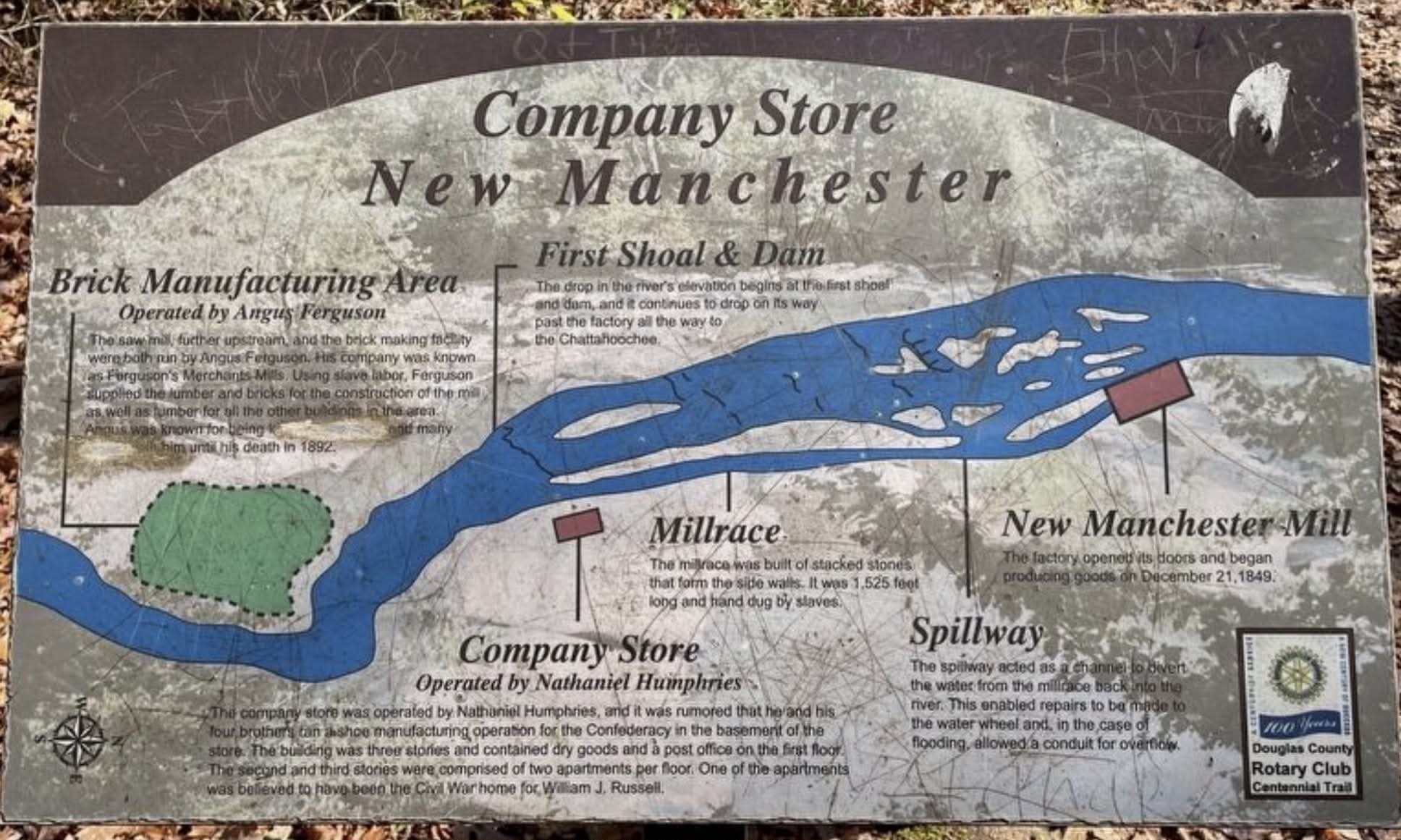
Records indicate that the textile company purchased large quantities of lumber from Ferguson’s sawmill. At one point the factory partners bought more than 35,000 board feet of lumber for improvements to the mill buildings. Bricks produced along Sweetwater Creek were also used in construction of the Manchester enterprise.
For a time, the two enterprises existed as partners in the industrial development of the creek valley, but eventually the relationship deteriorated.
Ferguson claimed that the dam constructed for the New Manchester factory caused water to back up the creek, interfering with the operation of his own mill upstream. At the same time, he alleged that the company still owed him money for supplies provided before the war—including meal, flour, lumber, and bricks.
The dispute resulted in legal action in Campbell County court.
Ferguson demanded more than $2,400 in damages and unpaid accounts. A compromise settlement was reportedly reached in which the company agreed to pay him $2,000 in installments with interest, but events soon overtook the agreement.
When the Civil War began in 1861, the New Manchester factory shifted its production to support the Confederate war effort. The mill produced cloth used for soldiers’ tents and other military supplies.
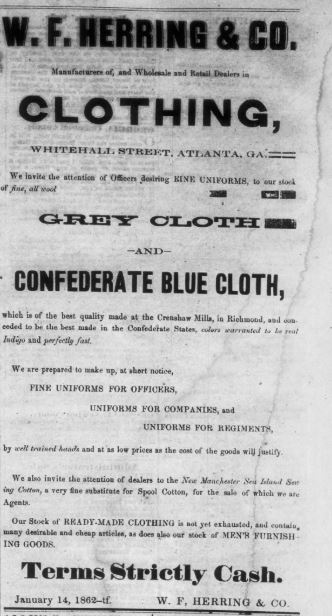
This 1862 advertisement from Atlanta merchant W. F. Herring & Co. seen below promotes “New Manchester Sea Island Sewing Cotton,” a locally produced thread offered as a substitute for imported spool cotton during the Civil War. Manufactured at the New Manchester mill on Sweetwater Creek, the product likely used high-quality Sea Island cotton—known for its long, strong fibers ideal for fine thread. As wartime shortages disrupted trade, goods like this reflect how Southern mills stepped in to supply everyday necessities once imported from the North or abroad.
Because of this involvement the factory became a target during the Atlanta Campaign of 1864.
Union cavalry under the command of Major Haviland Thompkins occupied the village in early July. A few days later the soldiers burned the factory buildings and surrounding structures. Dozens of workers—many of them women and children—were arrested and marched to Marietta before being transported north along with Roswell mill workers where they remained until after the war. Myths abound that the workers were never heard from again, but most can be traced and their final whereabouts are known.
The destruction ended New Manchester’s brief but dramatic industrial life.
The fate of Ferguson’s mill during these events is less certain. Some accounts claim the mill survived the campaign, while others suggest that portions of the operation were destroyed by Union troops.
Some accounts mention soldiers belonging to elements of the Illinois and Kentucky cavalry did visit Ferguson’s mill complex, but left the structures alone taking some grain, feeding some corn to their horses, and burned some wool. Others state that Ferguson realizing Union troops were in the area hung a large white flag from his mill which led to it being spared.
In 1958 Robert L. Griggs, the editor of the Douglas County Sentinel at the time, published “Only Ghosts Live at Wilderness Mill” in The Atlanta Journal Sunday Magazine (December 21, 1958) where he repeated the often-told tale stating,” …Whether the story is true or not, folklore in Douglas County says that ole Angus being a practical man, hastily ran up a white flag on the roof of his mill to indicate to the approaching soldiers, a part of General Sherman’s band going into Atlanta, that he was more of a friend than a foe. Because of his action, true or not, for some reason the pillaging and foraging group didn’t apply the torch to the canny Scot’s possessions and Ferguson’s Mill on Sweetwater was to stand and be used for many more years…”
Mr. Griggs received some push back regarding his account regarding the Ferguson Mill when on the Sunday magazine published a letter from Medora Field Perkerson (1892-1960) a couple of weeks later (January 11,1959) citing proof that Angus Ferguson did suffer the loss of his mill at the hands of the Union soldiers. Mrs. Perkerson knew what she was talking about as she was a journalist and author herself, and she was married to Angus Ferguson’s great grandnephew, Angus M. Perkerson (1888-1967), the retired editor of the Sunday magazine.
Her proof that Ferguson’s Mill was destroyed by Union troops was a family letter published in the Georgia Historical Quarterly (December 1944). Mrs. Perkerson stated in her letter to the Sunday magazine, “…No white flag was ever raised over [Angus Ferguson’s] original mills on Sweetwater Creek. Proof of this is found in a five-thousand-word letter, reprinted in the Quarterly, which was written by Elizabeth “Lizzie” Perkerson on December 2, 1864, to her brother Angus Perkerson, Sr., who had enlisted in the Confederate army at sixteen.
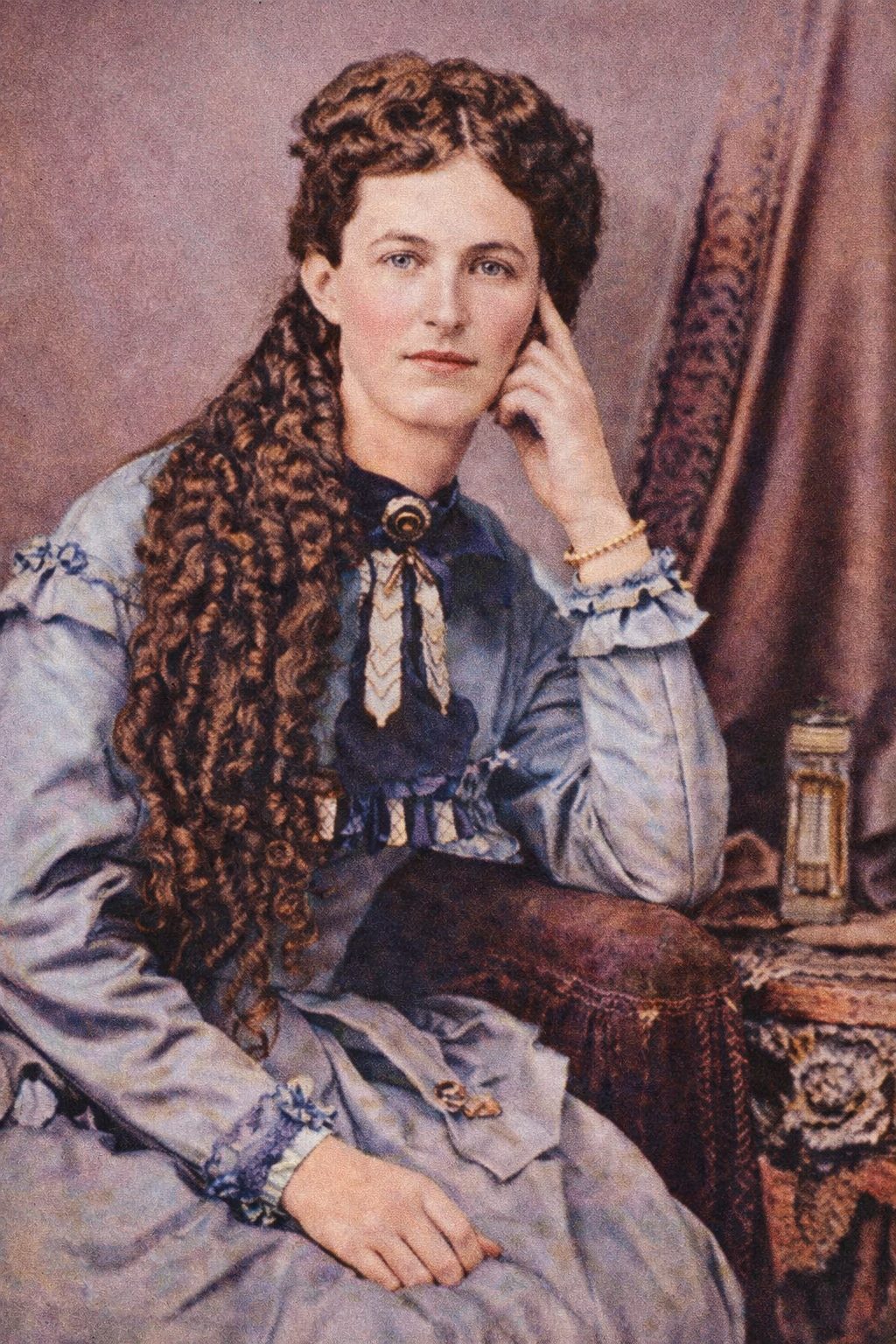
Elizabeth “Lizzie” Perkerson (1836-1934) and her brother, Angus M. Perkerson, Sr. (1843-1895) were the children of Isabella and Thomas Jefferson Perkerson mentioned earlier in this article and the niece and nephew of Angus Ferguson. Lizzie’s brother survived the war and went on to follow in his father’s footsteps becoming sheriff of Fulton County.
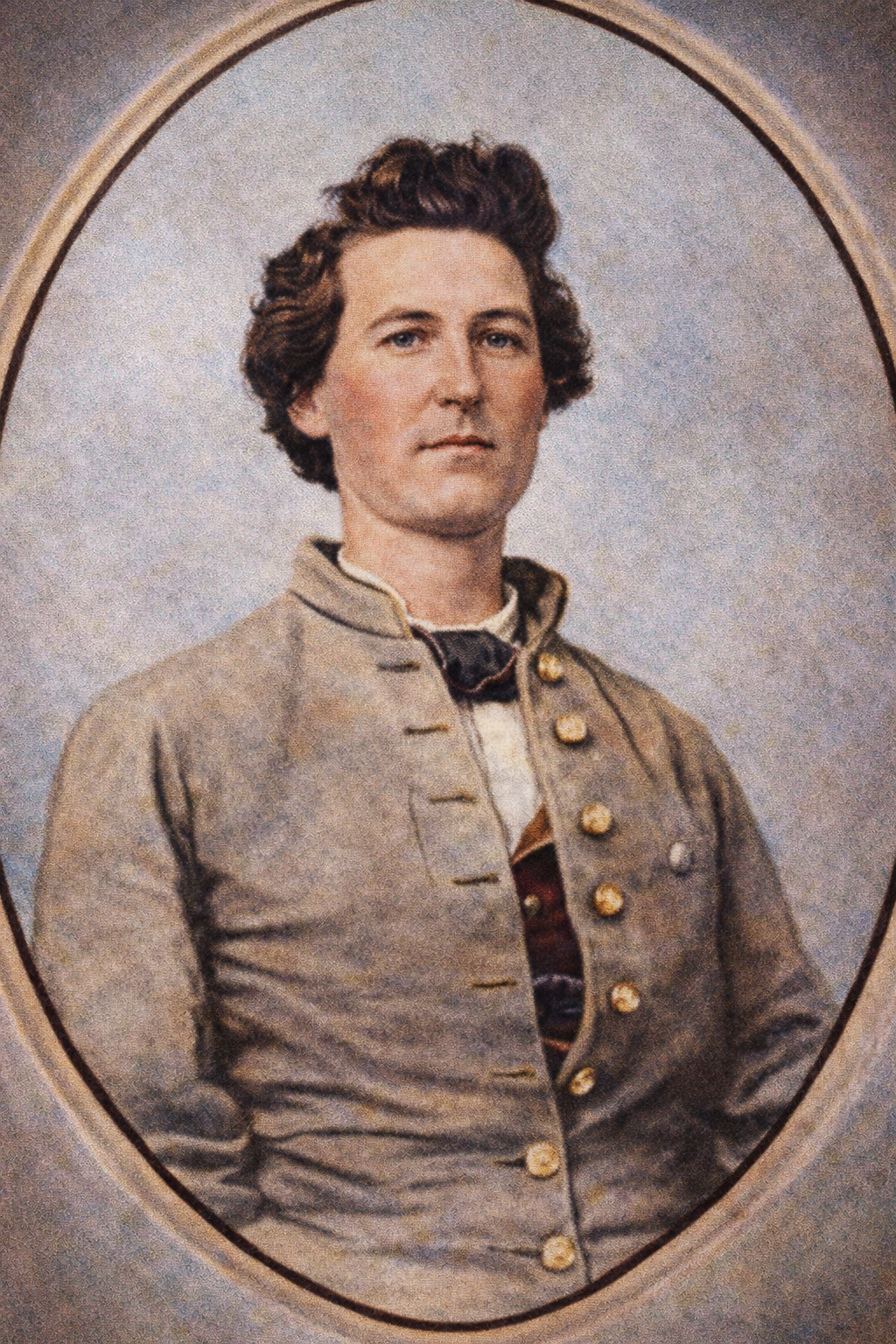
I plan to share the entire letter in a future article, but for my purposes here I will share the section of the letter where Lizzie mentions her uncle Angus Ferguson where she states, “Uncle Ang (Ferguson) was here last week. They burned his mills and workshop, but he says he will rebuild them again and will probably be able to make some improvements in the old plan.”
Six words from the five-thousand-word letter are key here: “They burned his mills and workshop…” indicating Angus Ferguson also suffered damage at the hands of the Union soldiers.
Whatever the extent of the damage, Ferguson resumed operations after the war. He hired Orange Bowden (1849-1910), a former slave belonging to John C. Bowden of Lithia Springs, as his miller. Bowden lived in a cabin near the rebuilt mill with his wife, Susanna Camp Bowden and their children. One son was named for Angus Ferguson. Orange Bowden is buried on Mack Road in Douglasville, Georgia at the Liberty Grove Cemetery.
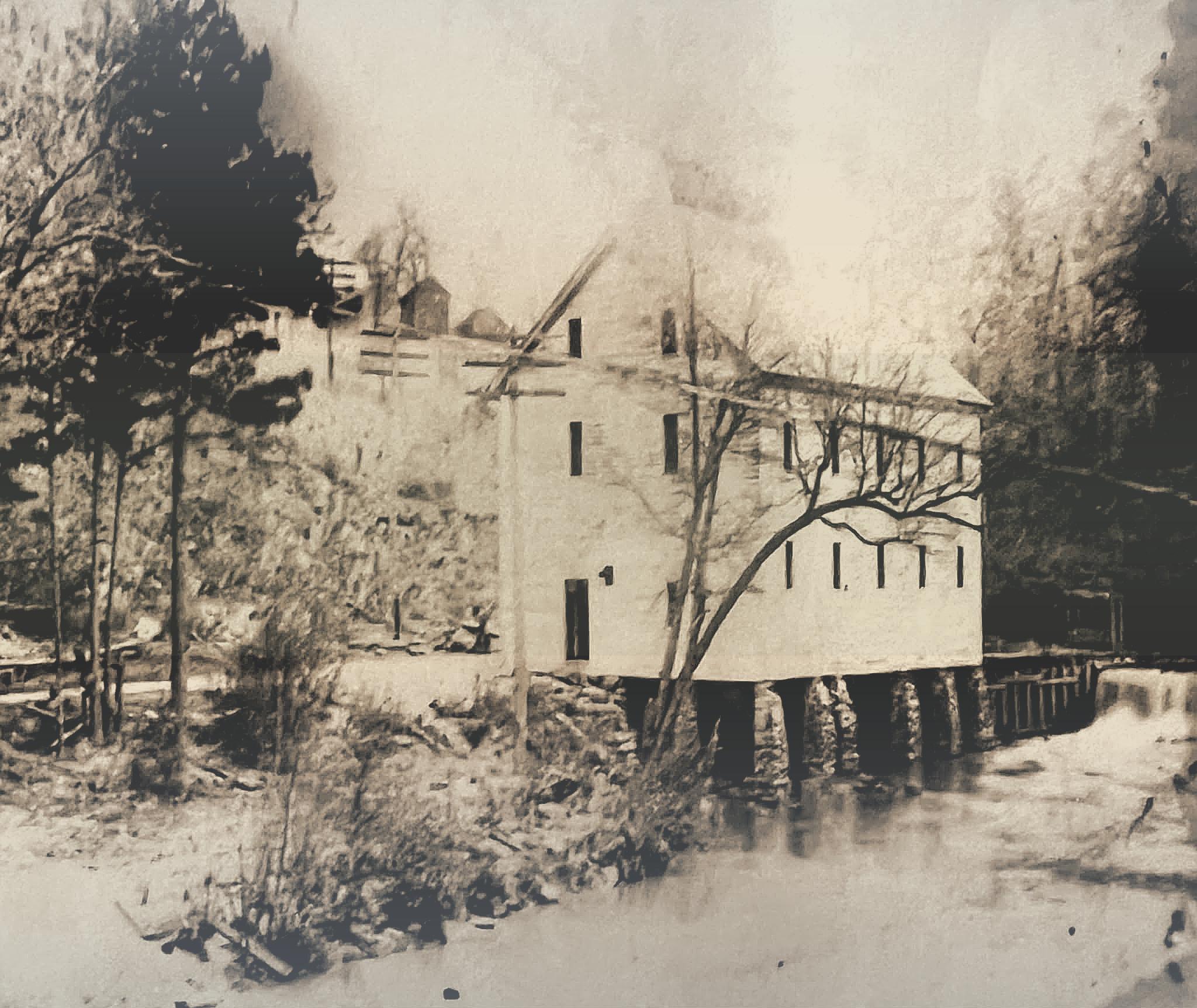
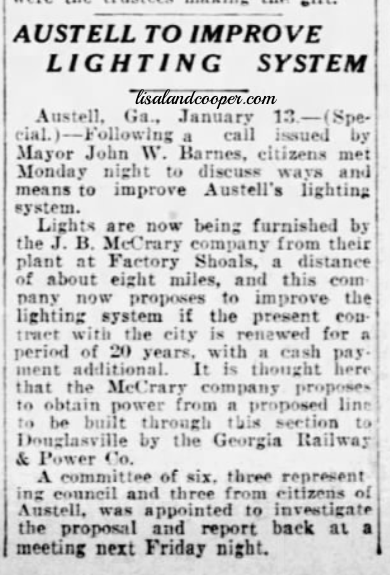
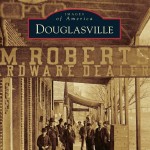
The building pictured below is Ferguson Mill where Orange Bowden served as the miller. It is the rebuilt mill following the Civil War and served as the cover photo for my book, “Every Now and Then – The Amazing Stories of Douglas County, Volume One.”
You can see the worker’s cabins up on the ridge above the mill.
In the years following the war Ferguson renewed his efforts to recover money he believed was still owed by the New Manchester company. The case eventually reached the Georgia Supreme Court.
In 1872 Ferguson succeeded in overturning a technical ruling involving a defective tax affidavit, allowing the case to proceed. But two years later the litigation collapsed on another procedural issue.
In Ferguson v. New Manchester Manufacturing Company (1874) the court ruled that the original suit had never been properly served, meaning the lower court had never obtained jurisdiction. As a result, the case was dismissed, and Ferguson’s claim effectively ended.
The dispute closed without ever resolving the underlying question of damages.
Despite the legal battles, Ferguson remained an important figure in the region.
His mill became a gathering place for the surrounding countryside. Fourth of July celebrations were held there in the late nineteenth century, drawing large crowds and political speakers. In 1879, local political figures – J.M. Edge, W.A. James, J.S. James, and B.P. Rogers spoke. In 1880, A.H. Cox of LaGrange spoke, and in 1881, Governor Alfred Holt Colquitt, General John B. Gordon (future governor 1886-1890), and Henry W. Grady from The Atlanta Constitution were invited to speak at Ferguson Mill. Court records and tax notices show that Ferguson’s Mill served as a local landmark where residents gathered for civic business including serving as a spot for the collection of taxes on into the 1920s and beyond.
Angus Ferguson never married and spent most of his life managing his extensive landholdings – at one point close to 700 acres – along Sweetwater Creek. The 1880 census listed him as a seventy-year-old miller living with several workers and household members.
Ferguson died on April 10, 1891, at the age of eighty-four. His obituary in The Atlanta Constitution described him as “one of Douglas County’s most notable citizens” and noted that he was the uncle of former Fulton County sheriff Angus M. Perkerson.
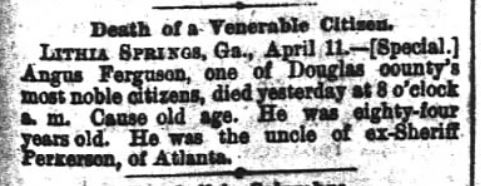
He was buried on a hill overlooking the creek near the site of his mill. Today that small family cemetery—containing only a handful of graves—lies hidden within Sweetwater Creek State Park. The Find-A-Grave website for the cemetery can be found here. The information for Angus Ferguson states he died in 1892, but the notice of his death is printed in the 1891 papers including this obit from The Atlanta Constitution dated April 10, 1891(84).
A video can be found here which provides information about the Ferguson burial site.
In the years that followed the old Ferguson Mill remained in use for various reasons.
By the 1920s, J.B. McCrary, a later owner of the mill property, adapted the waterpower for other uses including supplying electricity to the nearby town of Austell.
The Ferguson Mill site was also utilized by campers and fishermen. Many considered the area of Sweetwater Creek at the Ferguson Mill site to be one of the best fishing spots in the area.
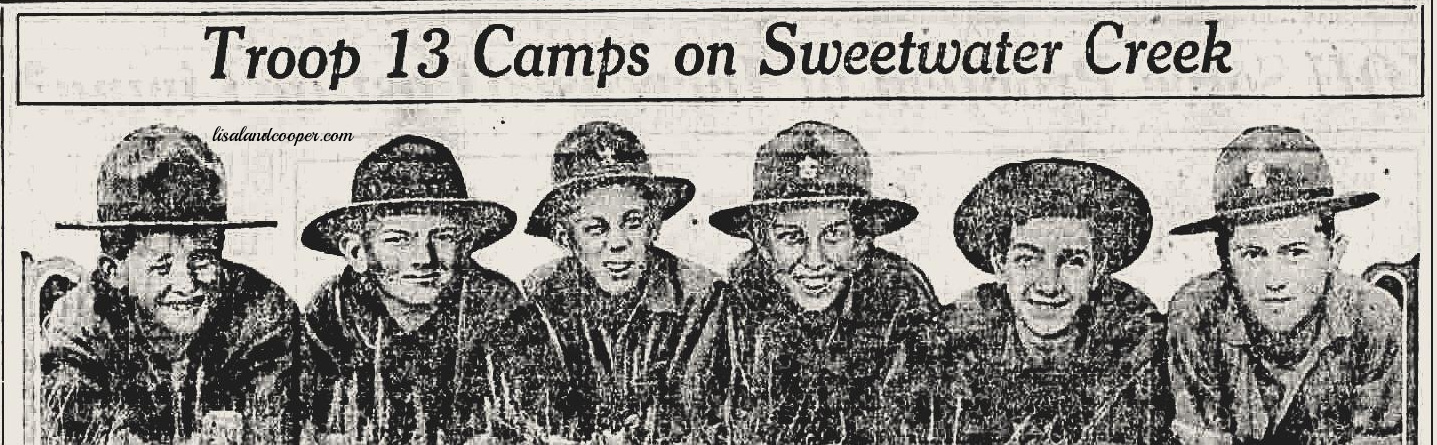
The group of Boy Scouts pictured below enjoyed a camping trip at Ferguson’s Mill at the end of August in 1919. One of the unidentified boys named Jack Branch wrote up a short description of their trip for the Atlanta Georgian stating the group was able to stay in the Factory Shoals area for a week. During their trip they boys did a bit of seining on Beaver Run Creek, held a snipe hunt ( I had to smile at that), and played in the water of Sweetwater Creek.
The group of boys also toured the New Manchester mill ruins where their Scoutmaster, A.E. Whitten, took several pictures, and one boy got permission to go into the mill building at Ferguson Mill. Jack said the mill was an “interesting place” where the workers were “grinding mill.” He also added that Ferguson’s Mill “generates electricity for Austell.”

Folks also considered Ferguson Mill area a great destination for a Sunday drive. The Atlanta Constitution for July 30, 1922 (5) gave a bit of history and driving directions to Factory Shoals area stating, “…at the crossroads turn right, ford stream. Cross bridge at mill and keep to the left…Just before reaching the site of the old factory one will notice a corner wall of the old office building standing on the right side of the road and an old iron safe on the left. The safe is said to have been cracked by soldiers and is still within a few feet of the spot where it once guarded the valuables of the cotton mill.”
I have to wonder what become of that old safe?
Eventually the entire area became part of the state park system as Sweetwater Creek State Park. Today visitors walking the trails along Sweetwater Creek often focus on the dramatic ruins of New Manchester downstream, but upstream, where the creek flows through rocky shoals, another story once unfolded. There Angus Ferguson built a mill that served farmers, supplied a textile factory, survived war and lawsuits, and remained a center of community life for decades.
Though little remains today, the history of Sweetwater Creek cannot be told without including Angus Ferguson.

Leave a Reply