Few images in American political history have carried as much meaning as the log cabin.
Long before television commercials, campaign websites and carefully staged photo opportunities, a candidate could be presented to voters with a simple picture: a rough-hewn cabin, a split-rail fence, a barrel of cider and perhaps a candidate standing nearby in shirtsleeves. The message required little explanation. This was supposedly a man of the people—someone who understood hard work, plain living and the concerns of ordinary Americans.
Sometimes the cabin was real. Sometimes it was symbolic. At least once, it was attached to a presidential candidate whose actual beginnings were about as far removed from frontier poverty as one could imagine.
The story of the “log cabin president” is therefore not simply about where presidents were born. It is about how Americans have chosen to imagine their leaders—and how politicians learned to turn biography into advertising.
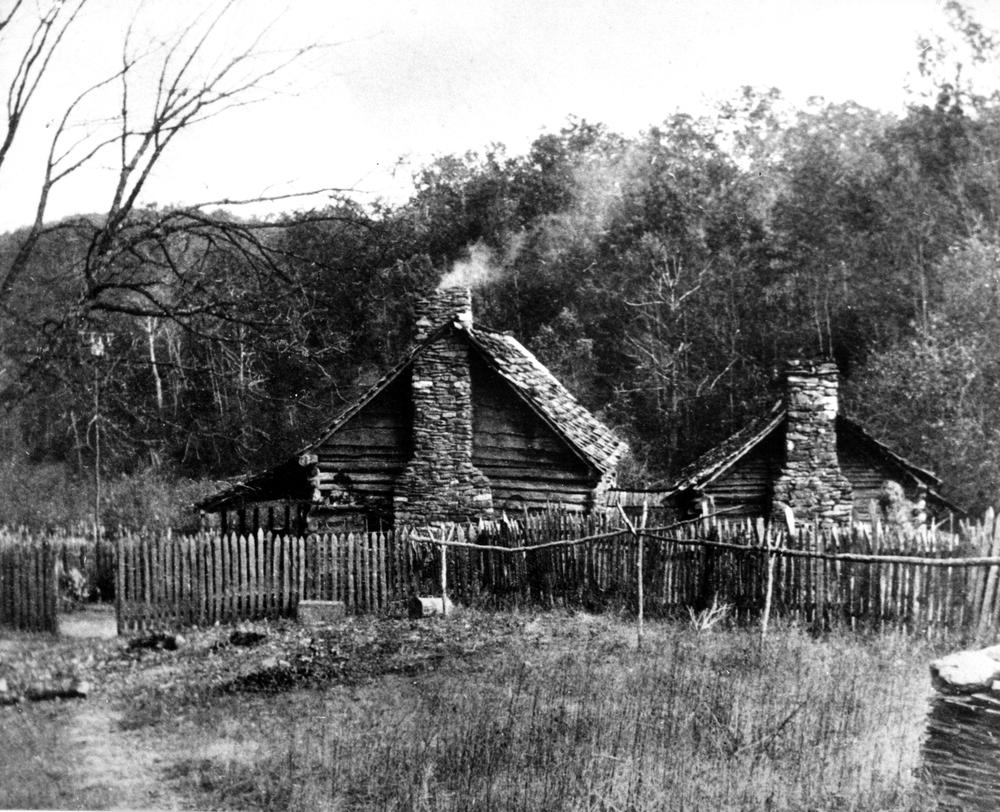
In the nineteenth century, the log cabin represented much more than a type of house. It evoked the frontier and all the qualities Americans associated with it: independence, physical labor, perseverance, self-reliance and the ability to create something out of very little.
A candidate connected to a cabin did not need to explain that he understood hardship. The cabin appeared to prove it.
It also supported one of the country’s favorite national stories—that in America, a poor boy could rise from obscurity to the presidency through talent, determination and honest work. It was the political version of the self-made man, reduced to a single recognizable image.
No campaign used that image more effectively than the presidential campaign of William Henry Harrison in 1840.
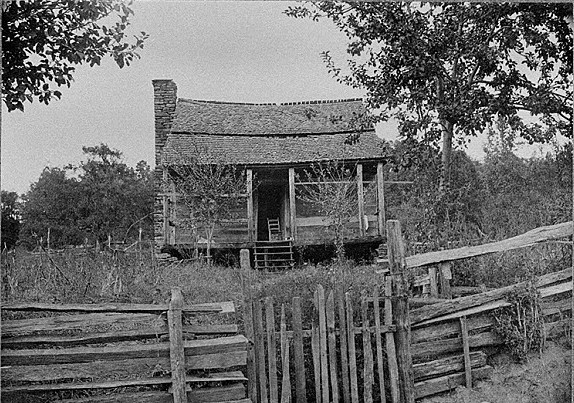
William Henry Harrison (1773-1841), the ninth President of the United States, was not born in a log cabin.
He was born in 1773 at Berkeley Plantation in Virginia, the son of Benjamin Harrison V, a signer of the Declaration of Independence and a former governor of Virginia. The Harrison family belonged to Virginia’s wealthy, politically connected, slaveholding planter class. William Henry Harrison received a classical education, attended Hampden-Sydney College and studied medicine before entering the army.
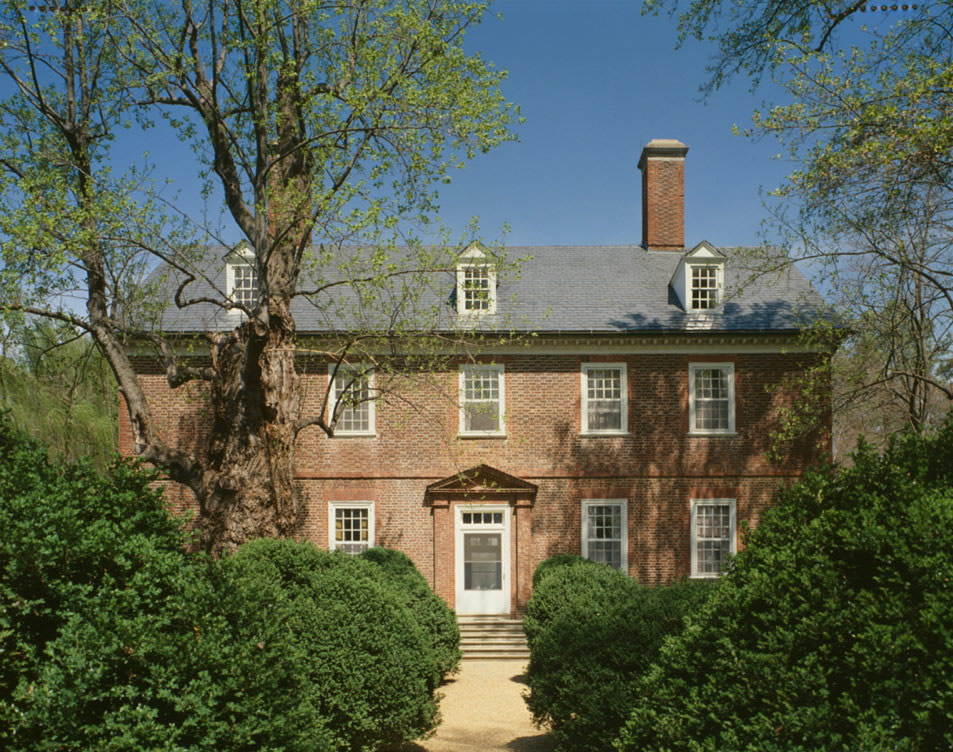
Harrison’s background hardly resembled that of a poor frontier farmer. Nevertheless, much of Harrison’s adult life was spent in the West, where he served as a military officer, territorial official and governor of the Indiana Territory. His military reputation rested largely on the 1811 Battle of Tippecanoe and his service during the War of 1812.
By 1840, however, Harrison was sixty-seven years old and had been out of the national spotlight for some time. The Whig Party needed to transform him from an aging officeholder and member of an old Virginia family into a vigorous champion of the common man.
The Democrats unintentionally showed the Whigs how to do this.
A Democratic newspaper attempted to dismiss Harrison as an elderly man who would be content to retire with a pension, a log cabin and a barrel of hard cider.
It was meant as ridicule.
Instead, the Whigs seized upon the cabin and cider, turning both into symbols of Harrison’s candidacy. The man mocked as a rustic retiree was recast as a plainspoken western hero who shared the habits and values of working Americans. His running mate, John Tyler (1790-1862), completed the famous campaign slogan: “Tippecanoe and Tyler Too.”
The contrast with President Martin Van Buren was carefully manufactured. Whig campaigners depicted Van Buren as a pampered aristocrat who dressed extravagantly, ate from fine dishes and lived comfortably while ordinary people suffered through the economic depression that followed the Panic of 1837.
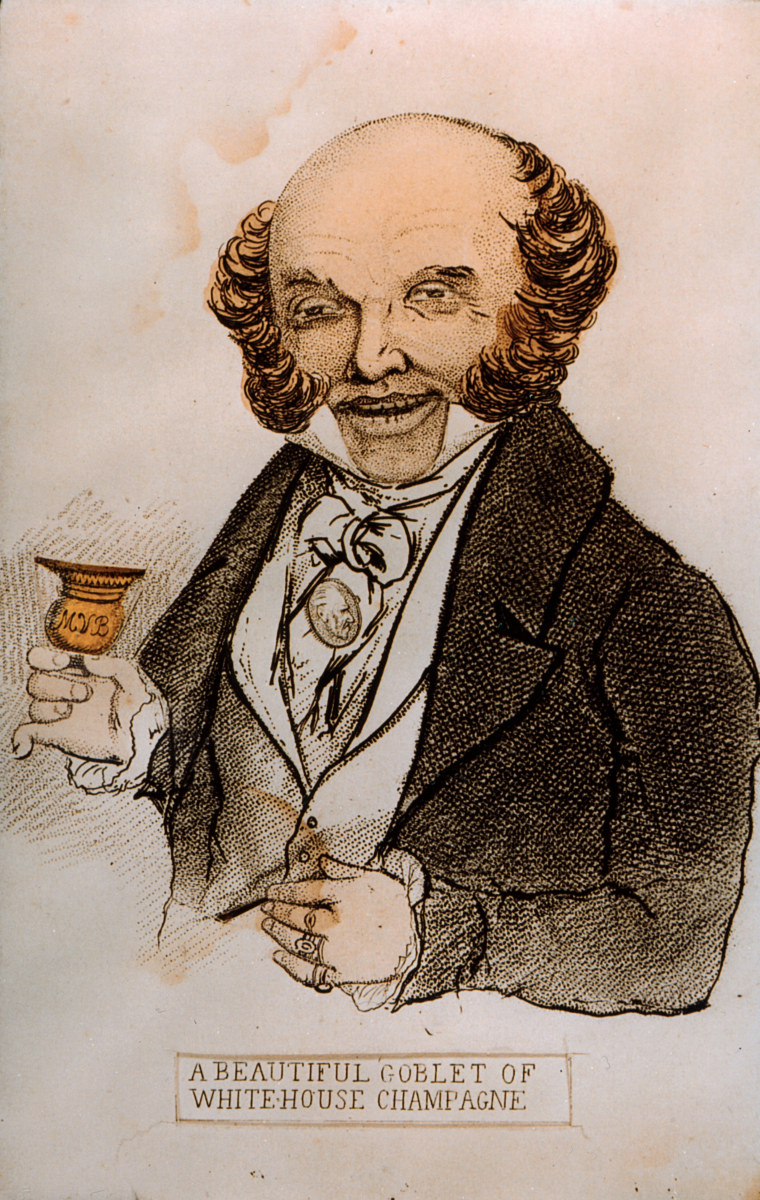
The irony was considerable. Van Buren had grown up around his father’s tavern and farm in New York, while Harrison had been born into Virginia’s planter aristocracy. In terms of family background, the cabin image probably suited Van Buren better than Harrison.
But political campaigns are rarely won by the biography that is most technically accurate.
They are won by the story voters remember.
I am going to repeat the last sentence because it’s important and something all responsible voters need to remember when investigating a candidate,
Political campaigns are won by the STORY voters remember.
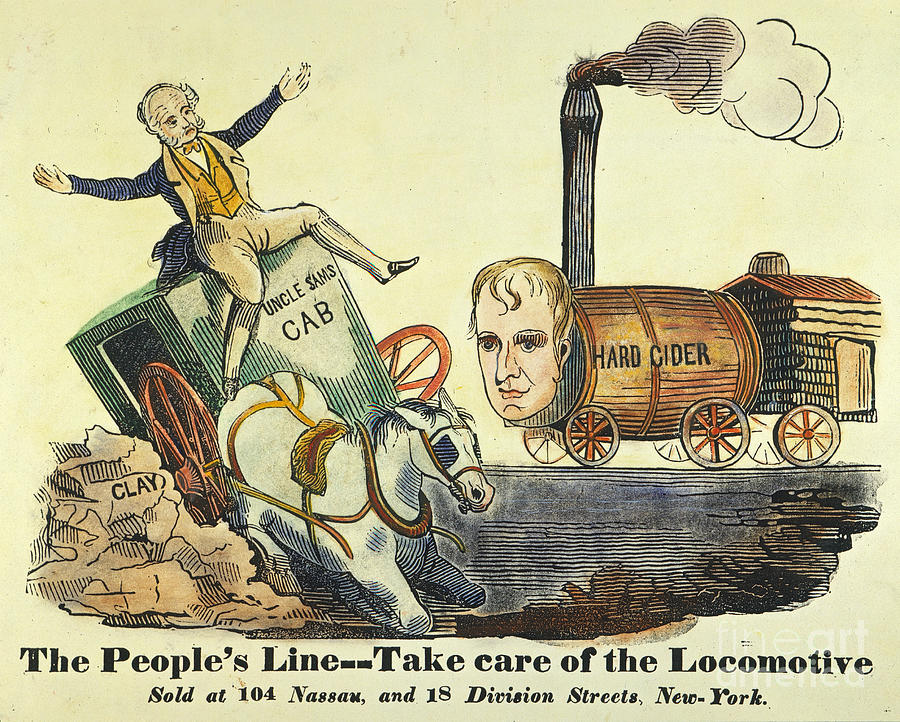
The above political cartoon shows the People’s Line–Take care of the Locomotive with a “Hard Cider” barrel locomotive with Harrison’s head bearing down on Martin Van Buren, whose cab has broken down over Henry Clay rocks.
The Whigs did not merely place a cabin in a few newspaper advertisements. They built an entire campaign culture around it.
Log cabins appeared on banners, badges, ribbons, prints, dishes, drinking vessels and sheet music. Some campaign events featured cabins mounted on wagons and rolled through the streets. Barrels of hard cider became fixtures at rallies, while supporters sang campaign songs and marched in enormous processions.
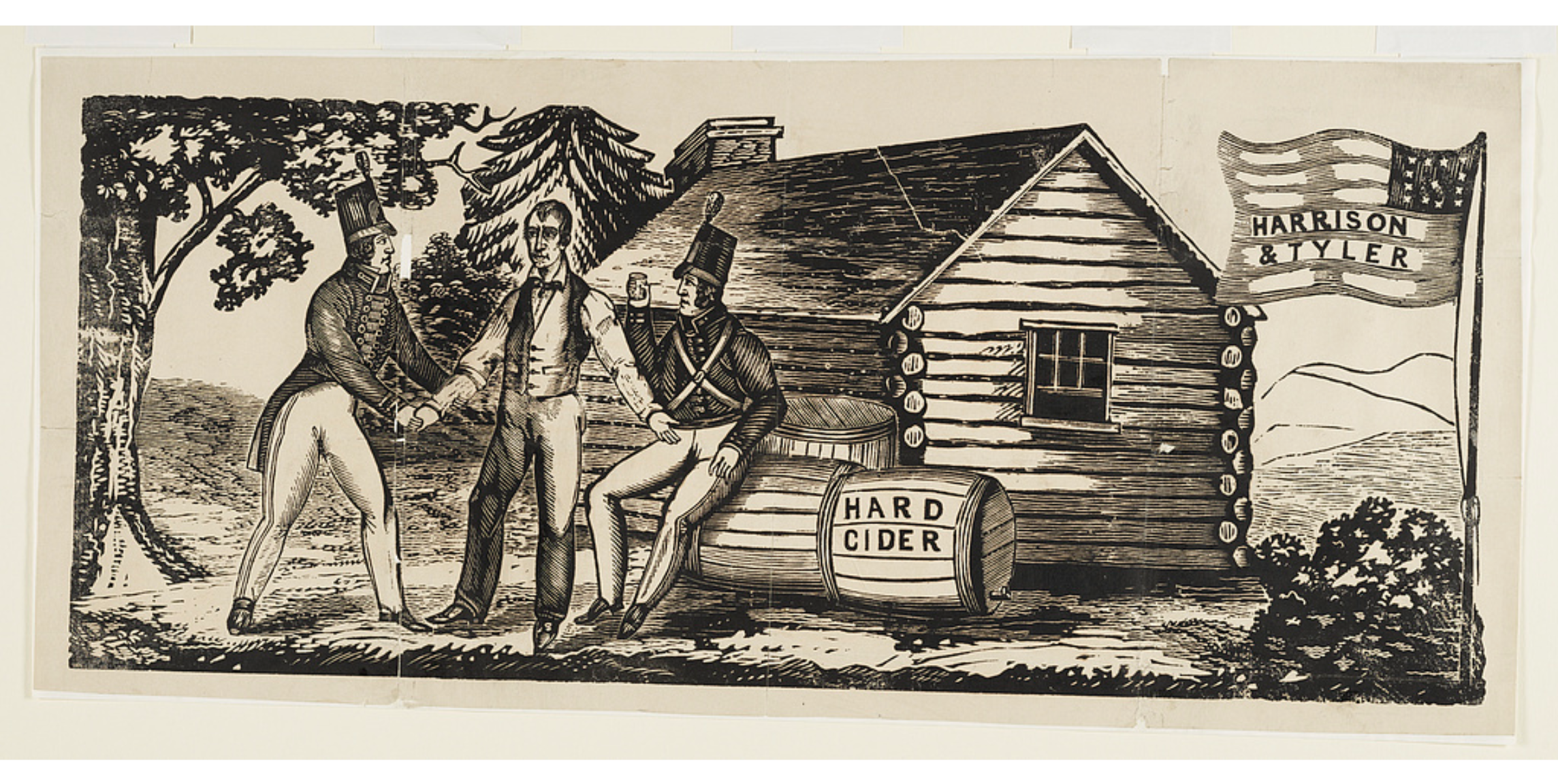
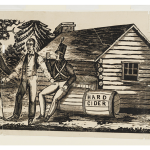
It shows Harrison standing outside a cabin, welcoming soldiers while offering them hard cider. The cabin displayed an American flag bearing the names “Harrison & Tyler.” The candidate appeared not as the educated son of a wealthy Virginia family but as an approachable neighbor ready to share a drink with veterans and working men.
The 1840 election is often described as one of the first modern mass presidential campaigns. The Whigs used slogans, songs, souvenirs, carefully constructed imagery and large public gatherings to create excitement.
They were not simply asking voters to support Harrison’s policies.
They were selling a personality.
The campaign turned politics into popular entertainment and made the candidate’s public image nearly as important as his position on the issues. The Miller Center of Public Affairs, an affiliate of the University of Virginia, describes the effort as an extraordinarily effective—and deceptive—example of political marketing.
Harrison won decisively.
The cabin campaign did more than exaggerate Harrison’s humble qualities. It obscured parts of his life that did not fit the heroic frontier story.
Harrison had indeed spent years in the Northwest Territory, but his work there was closely connected to the expansion of white settlement onto Native American lands. As territorial governor, he negotiated agreements through which Indigenous nations surrendered millions of acres. When Native resistance increased, Harrison used military force, most famously at Tippecanoe.
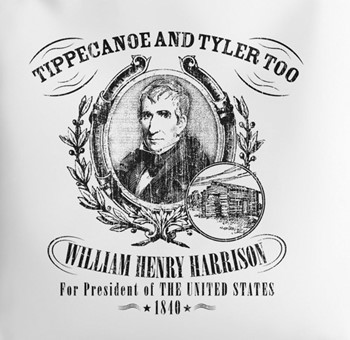
The campaign transformed this complicated history into a simple tale of military courage.
It also concealed the social world from which Harrison had come. The log cabin suggested poverty and equality, but Harrison had been born into a family whose wealth and position depended in part upon enslaved labor.
Even his financial circumstances were more complicated than the campaign admitted. Harrison was not always financially secure and experienced considerable debt, but financial trouble is not the same thing as being born poor. His connections, education and family name provided opportunities unavailable to most Americans.
The cabin allowed voters to overlook those distinctions.
Importantly, the Whigs did not need to issue a plainly worded statement claiming that Harrison had been born in poverty. The image performed the work for them. Voters saw the cabin, the cider barrel, the homespun clothing and the frontier scenes. They were encouraged to draw the desired conclusion.
That is what made the campaign so effective. The strongest political myths are often built not upon a direct falsehood, but upon a carefully arranged selection of truths, half-truths and suggestions.
Twenty years later, the Republican Party introduced the country to a presidential candidate whose cabin story was genuine.
Abraham Lincoln, the sixteenth President of the United States, was born in a one-room log cabin on Sinking Spring Farm in Kentucky on February 12, 1809. His family later moved to another farm at Knob Creek before leaving Kentucky for Indiana.
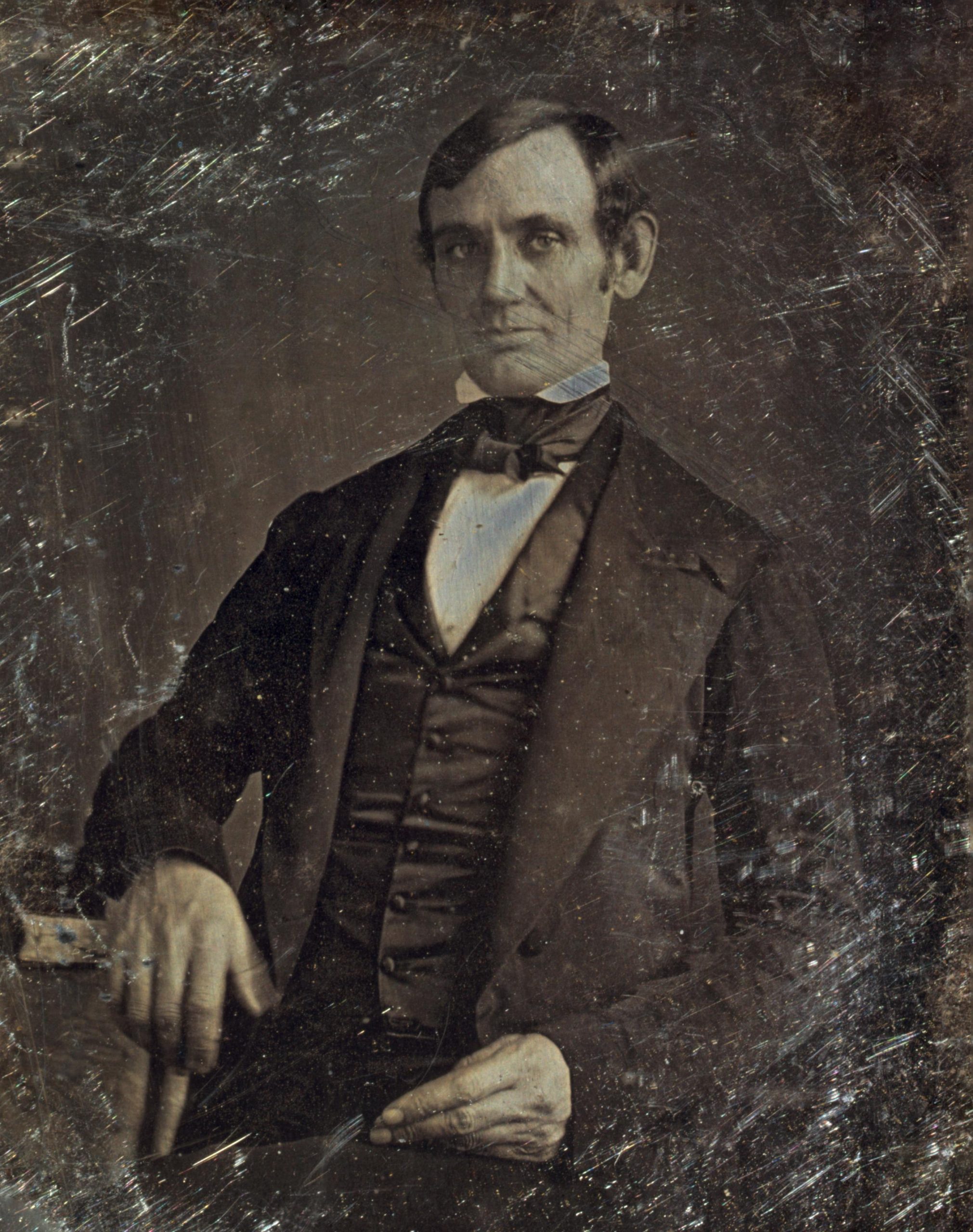
Unlike Harrison, Lincoln truly came from a frontier household with limited financial resources. He performed farm labor, split rails, worked on flatboats and received little formal schooling. His rise through law and politics offered powerful evidence for the ideal that ability and ambition could overcome humble beginnings.
Republican campaigners emphasized that background in 1860. Lincoln became known as the “Rail-Splitter,” and campaign processions featured rails, fences, cabins and other reminders of his western upbringing. A surviving campaign broadside defended him against critics who ridiculed him as “low born” and a former common laborer.
In Lincoln’s case, the humble beginning was not invented. Yet it was still polished into a political narrative.
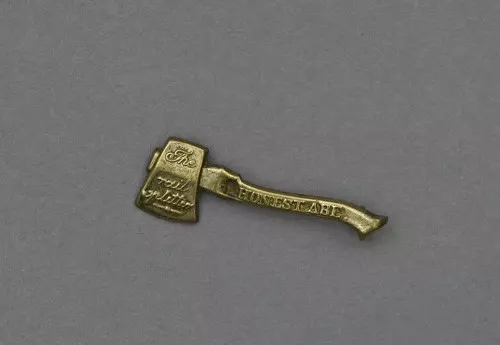
Lincoln had been a successful attorney, a former congressman, a state legislator and one of the country’s most prominent political speakers by the time he became the Republican nominee. The rail-splitting image was accurate, but it represented only the beginning of his story. It allowed campaigners to present an accomplished lawyer and politician as an unspoiled representative of ordinary labor. The Lincoln bronze campaign pin seen below dates to 1860. The axe was used as insignia for the Railsplitter party in the Presidential election of 1860. Lincoln was dubbed “The Railsplitter” by the Republican Party, a name that recalled his youth. Printed in raised letters on blade: “the rail Splitter”, and in raised letters on handle: “Honest Abe”. A small ring is attached to back of the handle.
The mythology surrounding Lincoln continued long after his death. The cabin became almost a sacred national object, symbolizing the distance between his birth and the White House.
The structure displayed at the Abraham Lincoln Birthplace National Historical Park is not the original cabin. It was once believed to contain some original logs, but the National Park Service now describes it as a symbolic birth cabin representing the simplicity of Lincoln’s early years.
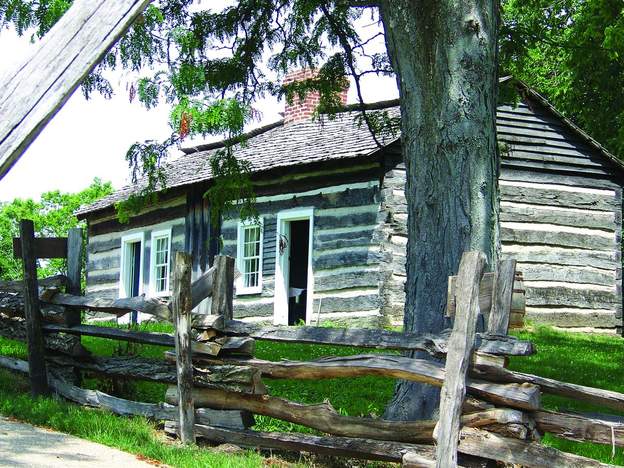
That does not make the site meaningless. In some ways, it makes it more revealing. Americans preserved not Lincoln’s actual cabin, which disappeared, but a physical representation of what they believed the cabin meant.
Lincoln was not the final president to be born in a log cabin.
That distinction belongs to James A. Garfield, the twentieth President of the United States, born in a cabin in northeastern Ohio in 1831. His father died when Garfield was two years old, leaving his mother to raise the family under difficult financial circumstances. Garfield worked, pursued an education, became a teacher and school administrator, studied law, served in the Civil War and entered Congress before winning the presidency in 1880.
Garfield’s life came remarkably close to the idealized cabin-to-White House story. The National Park Service identifies him as the last American president born in a log cabin.
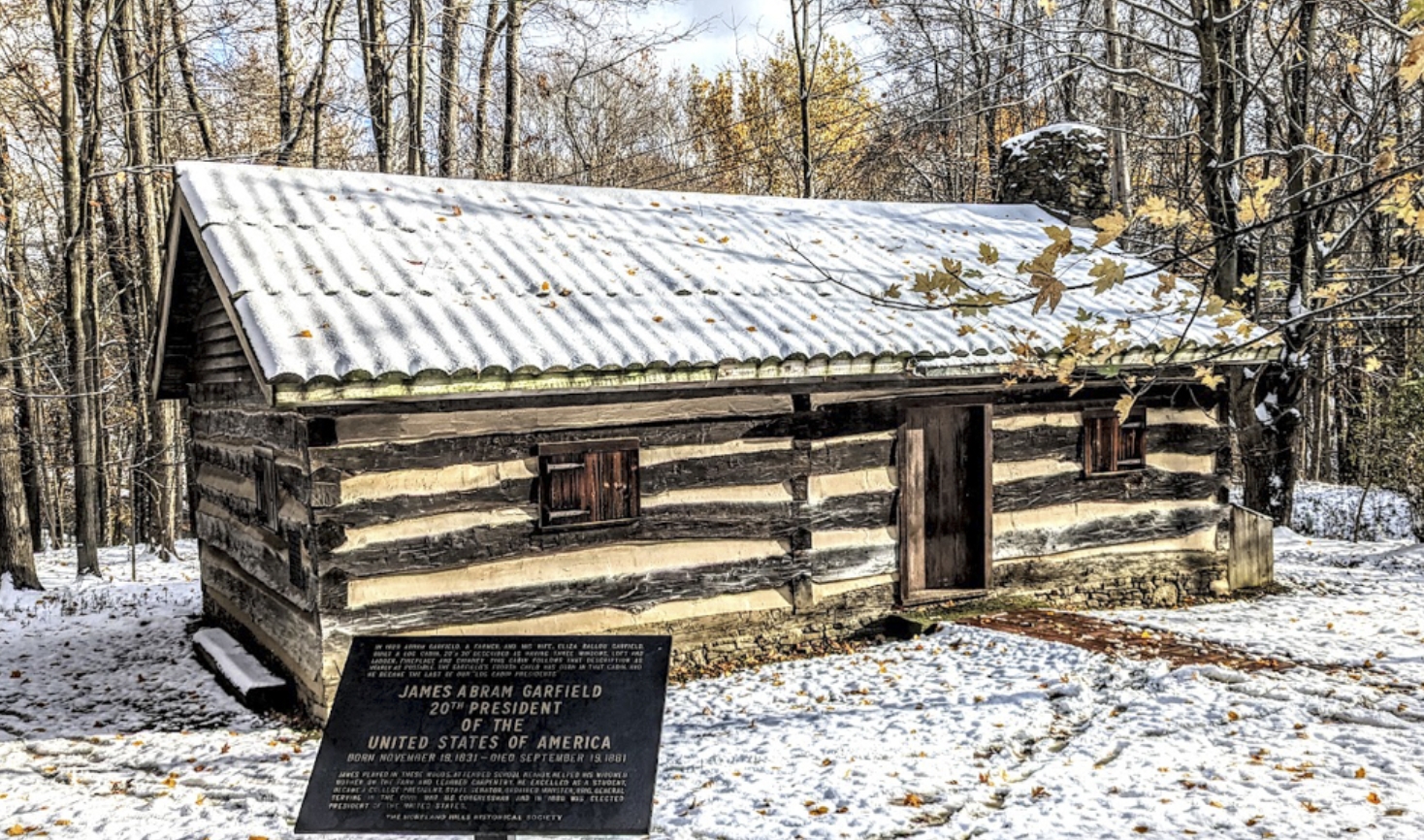
Yet Garfield’s rise also demonstrates what the simple myth leaves out. A cabin did not create him. His advancement depended upon his mother’s determination, educational opportunities, religious and community connections, political alliances, personal intellect and years of public service.
The cabin makes an appealing opening chapter, but it cannot explain the entire book.
The popularity of the log cabin image tells us something important about the United States.
Americans have often distrusted inherited privilege while simultaneously electing men who possessed it. Candidates from wealthy or politically connected families have therefore looked for ways to demonstrate that they understand ordinary life. They visit farms, factories, diners, construction sites and small businesses. They remove their jackets, roll up their sleeves and allow themselves to be photographed eating local food.
The nineteenth-century cabin served much the same purpose.
It reassured voters that the candidate had not been softened by wealth, corrupted by luxury or separated from the people. Whether the cabin was literal mattered less than whether the candidate appeared to embody the values associated with it.
The myth also made the American political system appear open to everyone. Each log cabin story carried an implied promise: no beginning was too small, no birthplace too remote and no family too unimportant to produce a president.
That promise contained some truth. Lincoln and Garfield genuinely rose from modest circumstances.
But the myth had limits. Political participation in their eras was restricted by race and sex, while economic advancement remained far more difficult for enslaved people, Native Americans, women and many laboring families than the cabin story acknowledged. The tale of one exceptional man rising to power could make the larger society appear more equal than it actually was.
The age of log cabin campaigning has passed, but the political strategy behind it remains very much alive.
Candidates still construct stories about themselves. They emphasize certain relatives, childhood homes, early jobs and personal hardships while placing less convenient details in the background. Campaign professionals still search for a single image that can tell voters, “This person is one of you.”
William Henry Harrison’s campaign helped demonstrate how successfully that could be done. He did not need to have been born in a log cabin. He only needed voters to associate him with one.
Lincoln then gave the country an authentic cabin story so compelling that it became part of the national memory. Garfield completed the familiar journey from a real cabin to the White House, although his presidency was cut short by assassination.
Together, their stories remind us that history and mythology are not always opposites. A myth may contain genuine facts while arranging them into a simpler, more satisfying tale.
The log cabin president represents an America in which greatness can emerge from obscurity, hard work can overcome circumstance and the highest office belongs not to an aristocracy but to the people.
It is a powerful ideal.
It is also a story Americans have repeatedly chosen to believe—even when the candidate standing beside the cabin was born on a Virginia plantation.

Leave a Reply